Challenge
Enterprise product teams often conduct research inside controlled environments that don't reflect how practitioners actually think, collaborate, and make decisions. VMware needed richer, more ecologically valid insight from design practitioners and enterprise IT professionals to inform product direction.
Constraints
Research had to be conducted in fast-paced conference settings with time-constrained participants, without access to controlled lab conditions or extended session windows. Every activity had to be high-signal and low-friction.
Success Metrics
Conduct high-quality research sessions with practitioners across multiple global conferences, generate actionable insights for product teams, and build lasting relationships with the design and enterprise IT communities.
Design Impact
Planning workshops, designer mentorship sessions, co-creation activities, and in-depth synthesis delivered practitioner insights that directly shaped VMware product and design strategy — while strengthening VMware's presence in the global design community.
OVERVIEW
Bringing Research Into the Field
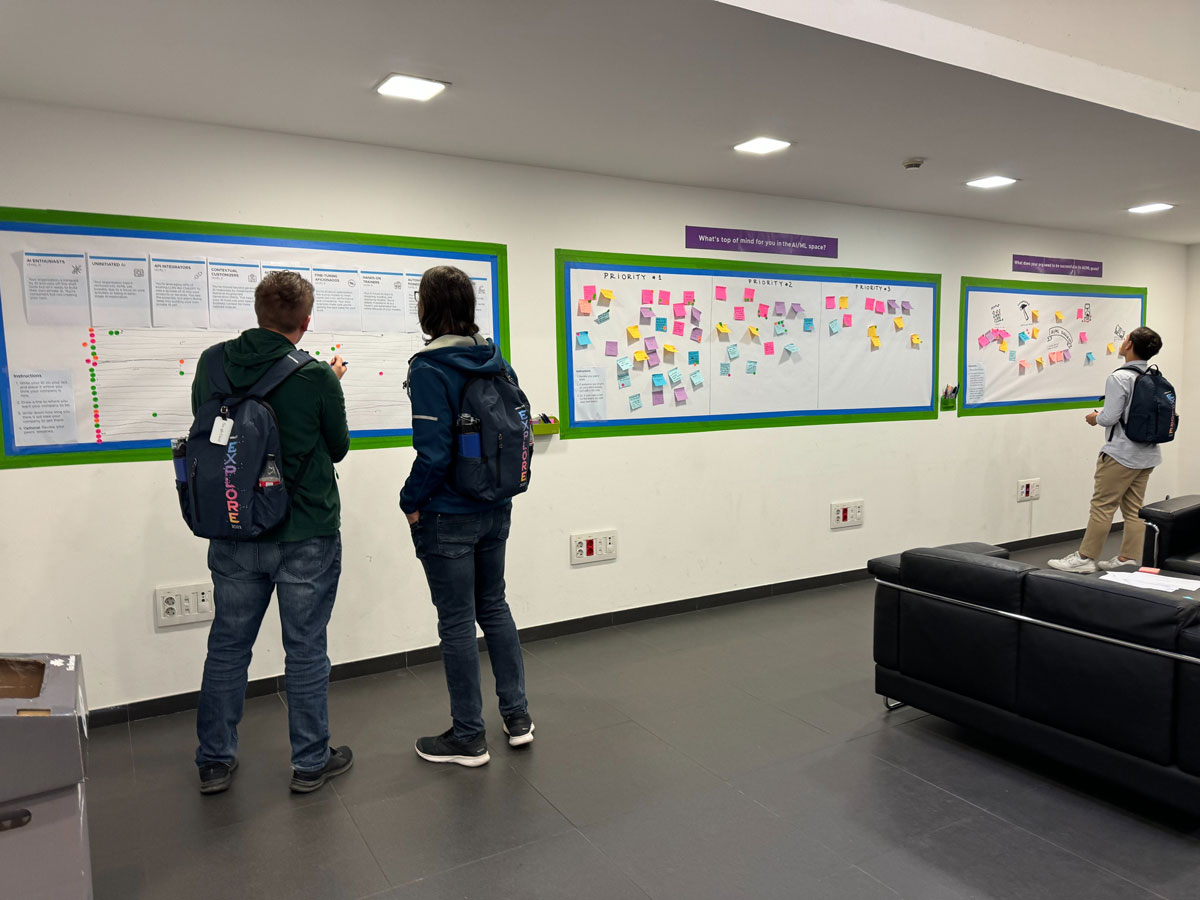
Enterprise user research is most powerful when it meets practitioners in their own professional context. This program brought VMware's design team to global design and technology conferences, events like company-customer-focused conferences, enterprise IT summits, and UX practitioner gatherings, to conduct in-context research that informed product strategy and built lasting community relationships.
The work combined structured workshop facilitation, one-on-one designer mentorship, group co-creation sessions, and in-depth synthesis activities, all adapted for the fast-paced, time-constrained environment of major professional conferences.
MY ROLE
Lead Researcher, Facilitator, and Community Builder
I co-planned and co-led all research activities across multiple conference events, from session design and participant recruitment through facilitation, synthesis, and stakeholder reporting. I also served as a designer mentor for practitioners attending conferences, offering structured feedback sessions and co-creation opportunities that provided value to participants while generating research signals for VMware's product teams.
TEAM MEMBERS
Who I Worked With
-

Design/Research Program Manager
Research operations and logistics
- Challenge
Coordinating research activities across multiple conference locations, time zones, and participant schedules without a dedicated research ops function.
- Goal
Ensure every session runs smoothly so the researcher can focus on facilitation and insight generation, not worring on logistics.
-
Product Manager
Stakeholder and insight consumer
- Challenge
Product decisions were being made without direct practitioner input. Leadership wanted richer signal from the communities the products served.
- Goal
Receive synthesized, actionable research findings that could inform and influence roadmap decisions within the current planning cycle.
-
Design Practitioners
Research participants and co-creators
- Challenge
Practitioners at conferences had limited time and high expectations — they came to conferences to learn and connect, not to be test subjects.
- Goal
Leave each session having gained something; a skill, a perspective, a connection, not just having given something.
CASE STUDY DEMO
Research in Action at Global Conferences
A demo of what the team did during of the year for planning, organizing, and planning UX research sessions at global and regional conferences.
THE CHALLENGE
Research That Doesn't Reach the Field
- Lab research misses practitioner context —
Controlled research environments produce clean data but miss the messy reality of how practitioners actually work. Conference settings capture practitioners in a state of active professional reflection, making them ideal research partners for understanding real-world challenges and aspirations.
- Enterprise product teams are disconnected from design community —
VMware's product teams had limited direct exposure to the global design and enterprise IT practitioner communities their tools served. Decisions were being made based on internal assumptions and infrequent customer visits — not ongoing community engagement.
- One-way research relationships don't build loyalty —
Traditional user research extracts from participants without giving back. Conference-based research offered an opportunity to build mutual-value relationships — where practitioners received mentorship, community, and co-creation experiences in exchange for their insights.
- Conference moments are underutilized for strategic research —
Most enterprise companies use conferences for marketing presence, not research. There was a clear opportunity to transform conference participation into a high-signal, community-embedded research channel.
PLANNING WORKSHOPS
Designing for the Conference Environment
- Session design adapted for time-constrained participants —
Every research activity was designed to deliver value within 30–45 minute windows — the realistic engagement window for conference attendees between sessions. Activities were high-signal, scaffolded, and participant-friendly: participants understood the purpose, felt respected, and left having gained something.
- Pre-conference participant recruitment and scheduling —
Participant recruitment began 6–8 weeks before each conference through community networks, LinkedIn outreach, and coordination with conference organizers. Scheduling was managed to avoid participant overlap with keynotes and high-demand sessions.
- Modular facilitation guides for variable session lengths —
Facilitation guides were designed modularly — a 30-minute version, a 45-minute version, and a 60-minute version of each core activity — so sessions could flex in real time to participant availability without losing research integrity.
DESIGNER MENTORSHIP
Mentorship as a Research Method
- One-on-one portfolio and practice reviews with design practitioners —
Structured mentorship sessions with design practitioners served a dual purpose: they provided genuine value to participants (feedback on their work, career guidance, craft conversations) while generating rich contextual data about how designers think about tools, workflows, and enterprise software challenges.
- Mentorship questions designed to surface latent needs —
Questions were framed around practitioners' real work — the tools they used, the decisions they wrestled with, the gaps they worked around. This approach surfaced needs that direct product questions rarely reach.
CO-CREATION SESSIONS WITH CUSTOMERS
Making Research a Collaborative Act
- Group co-creation workshops with 6–10 practitioners —
Small-group co-creation sessions brought practitioners together to collaboratively define problems, sketch solutions, and react to early design concepts. The group dynamic amplified insight — practitioners challenged each other's assumptions and built on each other's ideas in ways one-on-one sessions never reach.
- Artifacts that participants co-owned —
Workshop outputs — problem maps, opportunity frameworks, sketched concepts — were shared with participants after each session. This reinforced the mutual-value relationship and created advocates who carried VMware's design thinking back into their own organizations.
IN-DEPTH SYNTHESIS AND ANALYSIS
Turning Field Data into Product Direction
- Same-day synthesis sessions after each conference day —
Research notes, photos, and artifacts were synthesized each evening during conferences — while observations were fresh. This prevented the insight decay that affects post-conference synthesis and allowed facilitation adjustments to be made the following morning.
- Cross-conference pattern analysis —
After each conference, findings were integrated with data from previous events to track emerging patterns, confirm themes, and identify geographic and community-specific variations in practitioner needs.
STAKEHOLDER DEMOS & INFLUENCE
Bringing the Field into the Room
- Stakeholder readouts with participant voices centered —
Research findings were delivered to product and design leadership as narrative readouts — anchored in participant quotes, video clips (with permission), and co-creation artifacts. This approach made practitioner voices tangible to stakeholders who hadn't been in the room.
- Research findings linked directly to roadmap decisions —
Each readout included a "so what" section mapping findings to specific product and design decisions. Research influence was tracked over the following quarter to assess how findings shaped actual choices.
- 98%
- engagement score of participants
- 55+
- hours of practitioner engagement
- 18%
- increase in panel session sign-ups
- 15%
- increase in unique participation
WORDS FROM CUSTOMERS
What Participants Said
-
This was the most valuable conversation I had at the entire conference directly with hands-on users, and I saw how they interact with our products. I came in expecting to answer questions; I left with an entirely different way of thinking about my own design practice.
-
Design with us delivers on all fronts, engaged customers, empowered teams, richer insights, and actionable plans we can trust. This is the new standard for research.
-
This was the best part of Explore. This was so much fun. It was great that you were listening. It challenges me. The collaboration was key.
EVENT ACTIVITIES
Research in Action
#VMExplorepic.twitter.com/uSmxQ33MuC
— VMware Design (@VMwareDesign) August 22, 2023
#VMwareExplore#VMwareDesign pic.twitter.com/GlJubKMMNb
— VMware Design (@VMwareDesign) August 23, 2023
#VMwareDesign#VMwareExplore pic.twitter.com/NahWlD0wjI
— VMware Design (@VMwareDesign) November 6, 2023
Co-creation workshops, mentorship sessions, and community engagement activities conducted across global design conferences.
EVENT PHOTOS
Global Conference Presence
Meeting users where they are, in their professional communities, at the conferences that shape their practice, unlocks a quality of insight you simply cannot get in a lab.
What This Taught Me
-
Ecological validity changes everything
Research done in the field, at conferences where practitioners are actively thinking about their craft, reveals insights that controlled settings often miss. In this kind of work, context is not noise; it is part of the signal.
-
Co-creation is faster than validation
Bringing participants into the design process as collaborators, not just evaluators, significantly shortened the time from insight to direction. Practitioners who help shape a direction are much more likely to advocate for it.
-
Community presence compounds over time
Each conference built on the last, as participants from one event referred colleagues to the next. Research at conferences is not only about collecting data; it is also about building the relationships that make future studies easier and possible.