Challenge
VMware Cloud Foundation Operations lacked a cohesive UX function to match the scale and complexity of its infrastructure monitoring surface. Fragmented design practices, no shared strategy, and a team that needed to grow, both in headcount and in influence, were the starting conditions.
Constraints
The team operated inside a large, matrixed enterprise organization where design influence had to be earned through demonstrated business outcomes, not granted by title. Growing the practice required building credibility in parallel with building the team.
Success Metrics
Build a team capable of shipping enterprise-scale UX, establish design as a strategic partner to product and engineering, and connect UX work to measurable business and customer outcomes, validated by industry recognition and customer co-creation programs.
Design Impact
A scaled UX team, a structured co-creation program with enterprise customers, a design strategy aligned to business goals, and industry recognition including DevOps Tech Leader Award for Cloud Management and two industry coalition partnerships.
OVERVIEW
Building the UX Practice for VMware Cloud Foundation Operations
VMware Cloud Foundation (VCF) Operations is the management platform for private cloud infrastructure at enterprise scale — used by VS administrators and cloud operations teams to monitor, diagnose, and manage virtual infrastructure across compute, storage, and networking.
My role was to lead and grow the UX team responsible for this platform. That meant building the team's capability and headcount, establishing a design strategy connected to business outcomes, creating a customer co-creation program that grounded design decisions in real operator behavior, and representing design as a strategic function — not a production service — inside a complex, matrixed enterprise organization.
MY ROLE
UX Manager, Strategist, and Team Builder
I owned the UX function for VCF Operations in VMware, from hiring and mentorship to design strategy and stakeholder alignment. My responsibilities spanned people leadership (growing the team, running design reviews, coaching individual designers), process leadership (establishing shared practices, design principles, and quality standards), and strategic leadership (aligning the design roadmap to business goals, representing UX to product and engineering leadership, and connecting team output to measurable outcomes).
It was a leadership role where design quality, team health, and business impact were all equally in scope.
- 9
- designers on the team at peak
- 3
- industry recognitions earned
- 2
- enterprise co-creation programs
- 1
- UX strategy adopted org-wide
KEY IMPACT
What This Leadership Engagement Produced
- A scaled, high-performing UX team —
Hired, onboarded, and developed a team capable of delivering enterprise-grade UX across a complex infrastructure monitoring platform — with clear career paths, shared design standards, and a culture of quality and customer proximity.
- Design strategy connected to business outcomes —
Established a design strategy explicitly anchored to VCF Operations business goals — customer retention, feature adoption, and operator efficiency — rather than design-internal metrics. This framing elevated UX from a feature service to a strategic partner.
- Customer co-creation program —
Launched and ran a structured co-creation program that brought enterprise customers into the design process at the formative stage — reducing late-stage redesign and building direct customer advocacy for the platform.
- Industry recognition for design and product quality —
The team's work contributed to recognition from the European Green/Digital Coalition, EMA Alliance 2024 AI-Assisted Ops recognition, and the DevOps Tech Leader Award for Cloud Management.
TEAM MEMBERS
Who I Worked With
-

Staff UX Designer
IC designer — owned key feature areas within VCF Operations
- Challenge
Navigating a complex, matrixed organization where design decisions required buy-in from multiple stakeholders across product and engineering.
- Goal
Deliver high-quality design work that shipped and had measurable impact on operator workflows.
-
Staff UX Researcher
Research lead — drove customer discovery and usability testing
- Challenge
Connecting research insights to design and product decisions in a fast-moving enterprise product environment.
- Goal
Build a continuous research practice that kept the team grounded in real customer needs across the product lifecycle.
-
Product Manager Partner
PM counterpart — co-owned product roadmap and design strategy
- Challenge
Aligning a complex, dependency-heavy roadmap with the design investments needed to deliver cohesive operator experiences.
- Goal
Create a shared product-design roadmap where UX investments were planned and sequenced alongside engineering capacity.
LEADERSHIP APPROACH
How I Led the Team
- Hiring for craft and cultural fit —
Built the hiring process around design portfolio review, structured critique sessions, and values conversations — not just résumé screening. The goal was a team that could operate with high autonomy while sharing a common standard for quality and customer proximity.
- 1:1s as a development tool, not a status check —
Weekly 1:1s with every designer were structured around career development, unblocking, and individual growth — not project updates. Project updates lived in shared tooling. 1:1 time was reserved for the conversations that don't happen in team settings.
- Design reviews as a learning culture practice —
Ran regular team design reviews that were psychologically safe — where sharing early, rough work was explicitly valued over polished presentations. The goal was to build a culture where designers sought feedback early and often, and where critique was a growth tool.
- Connecting individual work to team and business impact —
One of the most motivating things I could do as a manager was help designers see the downstream impact of their work — in user behavior data, in customer feedback, in product metrics. Closing that feedback loop was a deliberate practice.
TEAM GROWTH
Growing the Team's Capacity and Influence
- Growing from individual contributors to organizational influencers —
The team's growth wasn't just headcount; it was influence and impact horizontally and vertically. I worked with each designer to build visibility inside the organization: sharing their work with leadership, getting them into cross-functional conversations earlier, and helping them develop the communication skills that turn good design into adopted design.
- Building design standards and shared practices —
Established shared design principles, component library contribution practices, and documentation standards that made the team's output more consistent and made onboarding new designers significantly faster.
- Performance and growth framework —
Co-developed a growth framework tailored to the UX function that gave designers clear criteria for advancement, grounded in craft, impact, and organizational contribution, rather than ambiguous seniority markers.
BUSINESS ALIGNMENT
Connecting Design to What the Business Needed
- Mapping UX investments to business outcomes —
Early in the engagement, I worked with product leadership to identify the three business outcomes where UX had the highest leverage: customer retention (reducing churn driven by poor operator experience), feature adoption (turning built capabilities into used capabilities), and operator efficiency (reducing time-to-value for enterprise customers onboarding to VCF).
- Creating a UX roadmap tied to the product roadmap —
Established a quarterly UX planning cadence synchronized with the product roadmap — so design investments were planned, resourced, and sequenced rather than reactive. This changed the conversation from "when can design look at this?" to "where is design investing this quarter?"
- Making design impact legible to leadership —
Built lightweight reporting that surfaced UX outcomes in terms leadership cared about — adoption rates, customer satisfaction scores, time-to-value metrics — rather than design-internal metrics like components shipped or screens designed.
- Aligning design strategy to VMware's Cloud transformation towards SaaS —
As VMware transitioned from on-premises to cloud-native operations, the design strategy had to evolve in parallel; anticipating new user needs, new mental models, and new operator workflows before engineering built them.
TEAM PROJECTS
Design Work the Team Shipped Under My Leadership
The following are selected projects that the team executed during this engagement. I played a player-coach role across these — setting design direction and strategy, unblocking design decisions, and collaborating on critical experience moments — while giving the team the ownership and autonomy to lead execution.
5.1 TIME-TO-VALUE · CUSTOMER ONBOARDING
Reducing Time-to-Value for Enterprise Customer Onboarding
Enterprise customers deploying VMware Cloud Foundation faced a steep onboarding curve; complex initial configuration, disconnected setup workflows, and no clear path to first value. The team redesigned the onboarding experience from first deployment through first successful operation, with a goal of reducing time-to-value for new customers.
The redesign was informed by embedded research with customer onboarding teams, structured interviews with IT administrators during their first 30 days, and co-creation sessions where customers participated in designing the onboarding flow alongside the team.
5.2 CO-CREATION SESSIONS WITH CUSTOMERS
A Co-Creation Program That Changed How the Team Designed
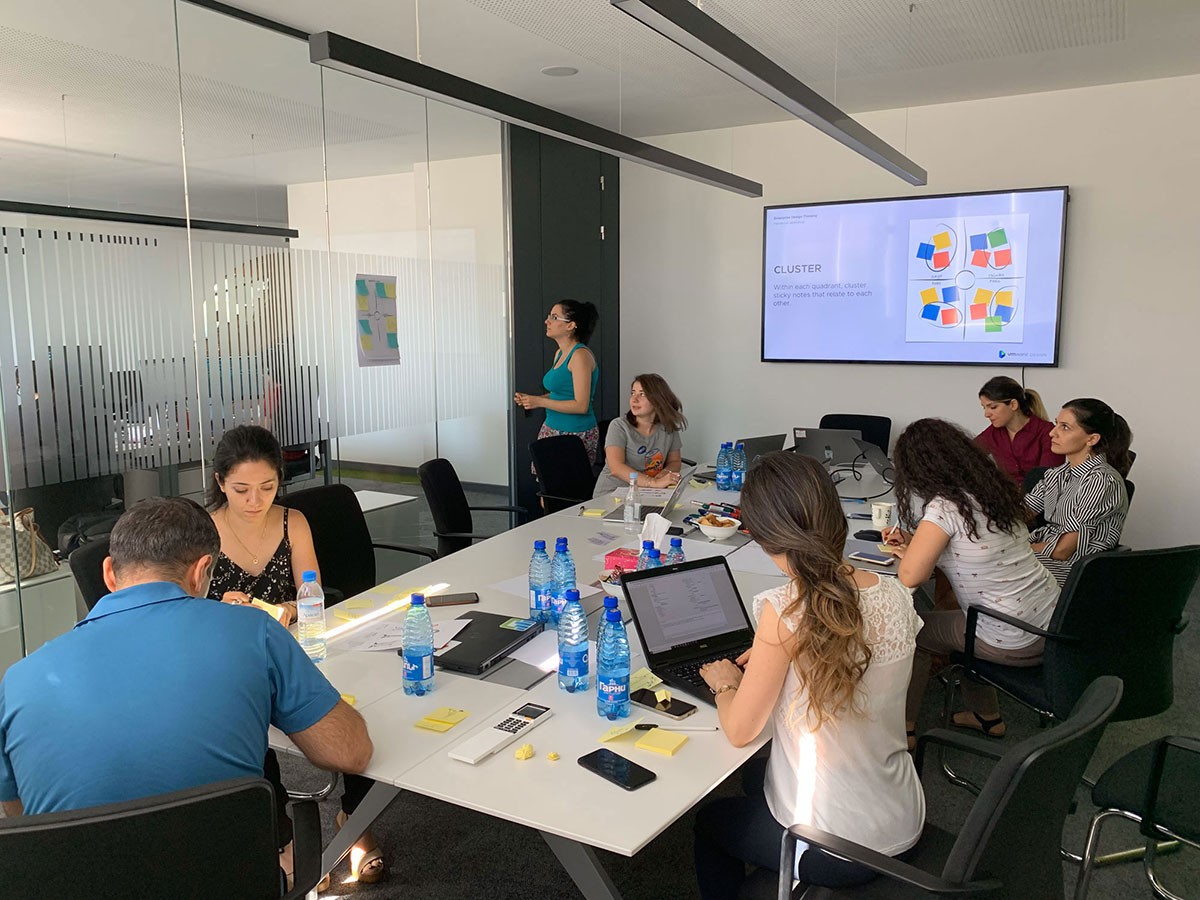
I established a structured co-creation program that brought enterprise customer teams — IT administrators, cloud operations leads, and IT infrastructure managers — into the design process at the formative stage, not just for validation.
Sessions ran in multiple formats: half-day working sessions where customers and designers mapped workflows together, remote participatory design exercises using digital whiteboard tooling, and longitudinal feedback panels where a cohort of operators provided ongoing input across multiple design iterations.
The program produced two outcomes that pure internal design couldn't: designs grounded in actual operator mental models rather than assumed ones, and a group of enterprise customers who became advocates for the product because they had participated in building it.
CO-CREATION SESSIONS
Customers as Design Partners
Structured co-creation sessions brought enterprise customer teams into the design process at the formative stage.
DESIGN STRATEGY
A Strategy Built for Enterprise Complexity
Designing for IT administrators and cloud operations teams is not like designing for consumer users. The mental models are deep and technical, the stakes are high (P1 infrastructure failures affect entire organizations), the workflows are complex and time-pressured, and the tolerance for design that prioritizes aesthetics over function is near zero.
The design strategy I established for the team reflected these realities. It was built around four principles that shaped every design decision: operator-first thinking, functional clarity over visual delight, trust through transparency, and progressive complexity (simple by default, powerful when needed).
Principles That Shaped the Team's Design Decisions
- Operator-first
Every design decision starts from the operator's mental model and workflow — not from the product team's feature list or the engineering team's implementation model. Understanding how VS administrators actually think about infrastructure is a prerequisite to designing for them.
- Functional clarity
In infrastructure monitoring, clarity is not a nice-to-have — it is a safety concern. Designs that are ambiguous or that require interpretation slow operators down and create risk during incident response. Functional clarity takes priority over visual polish.
- Trust through transparency
Operators trust systems they can inspect. Whether it's AI recommendations, alert logic, or monitoring thresholds — surfacing the reasoning behind system outputs builds the operator trust that drives adoption and reduces error.
- Progressive complexity
VCF Operations serves operators across a wide range of experience and context — from first-day deployments to deep infrastructure diagnosis. The right pattern is simple by default, with depth accessible when needed — not the reverse.
DESIGN PRINCIPLES
Toolbox for Deliverable Effectiveness
Design principles and guideliness were documented as shareable artifacts, used in design reviews, stakeholder conversations, and onboarding new team members.
AWARDS & RECOGNITIONS
What the Team's Work Was Recognized For
- 3
- designers hired and developed
- 3
- industry awards earned
- 2
- enterprise co-creation programs
- 1
- UX strategy adopted org-wide
8.1 EUROPEAN GREEN/DIGITAL COALITION
VMware's Alignment to European Digital and Sustainability Standards
- Design enabling regulatory alignment —
VMware Cloud Foundation's sustainability and digital operations capabilities — including work designed by this team — were recognized as aligned to European Green and Digital Coalition standards. This connected infrastructure monitoring UX directly to enterprise ESG reporting requirements across European markets.
- Reducing cost and carbon footprint dashboard —
Green Score dashboard, carbon reporting surfaces, and energy efficiency monitoring.
EUROPEAN GREEN/DIGITAL COALITION
European Sustainability and Digital Standards
Recognition from the European Green/Digital Coalition for VMware Cloud Foundation's sustainability and digital operations alignment.
8.2 EMA ALLIANCE 2024 — AI-ASSISTED OPS
AI-Assisted Operations Leadership Recognition
- Independent analyst validation of AI operations design quality —
The Enterprise Management Associates (EMA) Alliance 2024 recognition for AI-Assisted Ops validated the team's work in designing AI-powered operations experiences that operators actually adopted and trusted. This recognition came from independent analyst evaluation — not a vendor-nominated process.
Cloud Management Excellence Recognition
REFLECTION
What Leading This Team Taught Me
Three years of leading a UX team in a complex enterprise environment produced a clear set of convictions about what makes design leadership effective — and what doesn't.
The most important shift was learning to lead with business outcomes, not design quality arguments. Design quality matters enormously — but in an enterprise product organization, the conversation that opens doors is the one about business impact. Once that framing was established, design had a seat at every table that mattered.
The co-creation program was the single highest-leverage investment the team made. It produced better designs faster, reduced stakeholder misalignment, and built a customer advocacy base that supported the product through difficult roadmap decisions.
Key Learnings
-
Design leadership is business leadership
The most effective moment for design influence is when UX outcomes are framed in business terms. That framing changed every conversation I had with product and engineering leadership — and it's a skill I'll carry into every leadership role I take on.
-
Co-creation with customers is not a research method — it's a strategy
Bringing customers into the design process at the formative stage accelerates alignment faster than any internal workshop. It also builds something internal workshops cannot: customer investment in the outcome.
-
Growing a team means growing individuals
Team capacity scales when individual confidence scales. The most valuable thing I did as a manager was help each designer see their own impact clearly — and give them the visibility, feedback, and development support to grow into it.
Growing a UX team isn't about managing designers — it's about creating conditions where great design thinking can thrive and directly move the business forward.